

Traders and economists increasingly expect the Reserve Bank of Australia to raise interest rates next week as the conflict in the Middle East drags on, triggering a spike in the oil price and leaving the central bank more worried about inflation.
National Australia Bank and Westpac are the first of the major lenders to forecast an imminent rate rise, with economists expecting the RBA to lift the official cash rate by a quarter of a percentage point in both March and May to a peak of 4.35 per cent.

Most economists had previously expected just one increase, in May, to 4.1 per cent. Commonwealth Bank and ANZ still expect the central bank will hold fire until May.
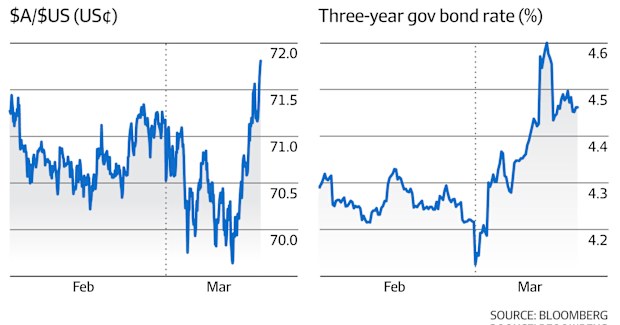
But hawkish comments from RBA deputy governor Andrew Hauser on Tuesday triggered a rapid rethink in markets. The Australia dollar shot up to US71.85¢, the highest since mid-2022, and bond yields jumped after the policymaker said it would be “bad for everyone” if the central bank did not act decisively.
Oil rocketed to almost $US120 a barrel earlier in the week as the escalation of the Iran war risked prolonged disruptions to the Strait of Hormuz, through which about 20 per cent of the world’s energy supply is shipped. Since then, Brent crude has declined and is trading around $US87 a barrel.
“Hauser was as hawkish as he should have been,” said Renny Ellis, head of portfolio management at Arculus Funds Management.
“There’s a strong possibility the RBA will hike next week. The RBA pays attention to inflation expectations data, and that would have scared them … They’ve got this excuse with the war.”
Money markets are pricing in around a 70 per cent chance of a move higher on March 17, up from 39 per cent before Hauser’s comments. Traders expect another increase in August, taking the rate to 4.35 per cent.
The RBA lifted the cash rate in February to 3.85 per cent – the first of the major central banks to do so except for Japan – after an unexpected pick-up in inflation in late 2025.
Speaking in a podcast interview with The Conversation’s Michelle Grattan on Tuesday, Hauser said he now expected inflation to rise above the RBA’s 4.2 per cent forecast by June, but stopped short of the 5 per cent suggested by NAB should oil hold above $US100 a barrel.
Headline inflation is currently stuck at 3.8 per cent, well above the central bank’s 2.5 per cent target.
Hauser’s signal to the market
With oil trading near its highest since Russia’s invasion of Ukraine in 2022 – which pushed inflation in Australia to 8 per cent – Hauser was clear that the RBA did not want a repeat scenario.
“We don’t want to go through that period again. So failing to raise rates to the level they need to be and allowing inflation to get out of control is a clear problem,” he said.
Hauser’s comments followed an equally stark warning from governor Michele Bullock at The Australian Financial Review Business Summit last week, when she said the March meeting was “live” to another move in rates, triggering strong moves in the bond markets.
“The combination of hawkish commentary from both the governor and deputy governor over the past week contains more signal than noise,” said NAB, led by chief economist Sally Auld, in a note on Wednesday.
“It is clear from their commentary that senior RBA officials are inclined to view the Iranian conflict as an inflationary shock.”
Auld said the debate was less about the direction of interest rates and more about the timing.
“Given the relatively unfavourable starting point for inflation in Australia and recent confirmation that the economy is running well above its trend rate of growth, the case for a near-term rate hike is clear.”
On Wednesday, the three-year bond yield, which reflects interest rate expectations, rose to 4.47 per cent, from a low of 4.43 per cent on Tuesday, while the 10-year benchmark rose to 4.89 per cent before dipping back to 4.86 per cent.
Other economists have also reacted swiftly. Bank of America was the first out of the gate on Tuesday to forecast a rate rise at next week’s RBA board meeting, but UBS, Capital Economics, Citi and Deutsche Bank have now followed suit.
“[Hauser’s] comments were not scheduled on the RBA website until today, so it was unexpected by the market (and UBS),” wrote UBS chief economist George Tharenou in its report to clients. “These comments can arguably be viewed as a ‘signal’, and helps to explain why the market pricing for a rate hike in March subsequently moved up so materially.”
Tharenou said stronger-than-expected economic growth in the fourth quarter of 2.6 per cent, combined with low unemployment and robust inflation, “warrant further (and earlier) increases in the cash rate”.
Capital Economics said the conditions for a sustained acceleration in inflation were already in place before the Iran conflict with the recent spike in oil prices adding further upside risk.